Hong Kong Mahjong · Guide
How to Play Hong Kong Mahjong: an Illustrated Beginner's Guide
Learn Hong Kong mahjong on one page: tiles, dealing, flowers, claiming, winning, the 3-fan minimum and payouts — all illustrated.
Hong Kong mahjong (Cantonese mahjong) is the game played in Hong Kong homes and mahjong parlours: four players, 13 tiles each, draw one and discard one in turn. The first player to complete four sets and a pair with at least 3 fan wins the hand. This page walks you from setting up the table to settling the score, and every rule matches the game on this site exactly.

On this page
What is Hong Kong mahjong and what do you need?
Hong Kong mahjong shares its roots with Taiwanese and Japanese mahjong. What makes it different is fan (points): a complete hand is not enough — it also needs enough fan to be allowed to win, and the more fan, the more the losers pay.
- Four players, seated around a square table, each holding a wind (East, South, West, North).
- A 144-tile set: 136 suit and honour tiles plus 8 flowers.
- Three dice to pick the dealer and decide where the wall is broken.
- A table — or just play free Hong Kong mahjong online: three computer players, fan counted for you.
The 144 tiles
Suit tiles come in three suits numbered 1 to 9, four copies of each:
Honour tiles come in seven kinds, four of each: the four winds (East, South, West, North) and the three dragons (Red, Green, White). Honours never form a run — only a set of three or a pair.
Flowers: eight tiles, one of each — the four seasons (Spring, Summer, Autumn, Winter) and the four plants (Plum, Orchid, Bamboo, Chrysanthemum). Flowers never stay in your hand; you lay them out as soon as you get them (see "Flowers" below).
For a closer look at every tile, see The tiles.
Seats, dealer and dealing
- Pick the dealer: roll the dice to decide who deals the first hand. The dealer is East; going round in playing order (anticlockwise) come South, West and North.
- Shuffle and build: turn every tile face down, mix them, and each player builds a wall two tiles high in front of them, forming a square.
- Break the wall: the dealer rolls three dice and counts round to one of the walls; the deal starts from that break.
- Deal: everyone takes 4 tiles at a time for three rounds, then 1 more each; the dealer takes one extra. So the dealer has 14 tiles, everyone else 13, and the dealer discards first.
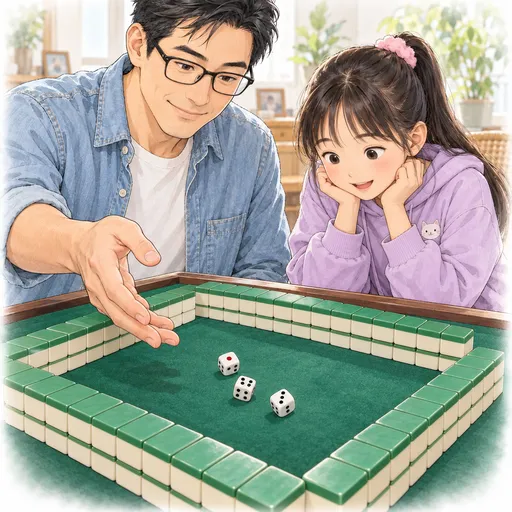
On this site the game does all of this for you: after the dice animation, the tiles are dealt.
Flowers
Flowers are not part of your hand. After the deal, starting with the dealer, everyone lays out the flowers they hold and draws the same number of replacements from the back end of the wall, until no flowers are left in hand. Drawing a flower later works the same way: show it at once and draw a replacement from the back.
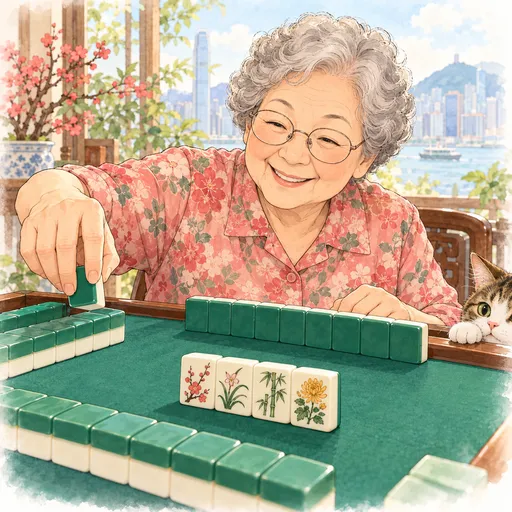
Flowers score fan:
- Own flower: a flower matching your seat is worth 1 fan each. East's are Spring and Plum, South's Summer and Orchid, West's Autumn and Bamboo, North's Winter and Chrysanthemum.
- No flowers: holding no flower at all is worth 1 fan.
- Flower set: all four of one group (the seasons or the plants) is worth 2 fan.
- All eight flowers: an instant win at the limit.
Your turn: draw and discard
The dealer discards first. After that, on each player's turn:
- Draw one tile from the wall.
- Decide what to keep.
- Discard one tile face up into the middle of the table, where everyone can see it.
Play passes anticlockwise: after you discard, the player on your right takes their turn. Your hand stays at 13 tiles, 14 right after you draw.

Claiming: chow, pung, kong
When someone discards a tile you need, you can call for it to complete a set. You show that set, then discard a tile.
- Chow: only from the player on your left, to complete a run — for example you hold and they discard .
- Pung: you hold a pair and anyone discards the third, making a set such as .
- Kong: four of a kind. Holding three and claiming a discard is an exposed kong; drawing all four yourself is a concealed kong; drawing the fourth to a pung you already showed is an added kong. After any kong, draw a replacement from the back of the wall.
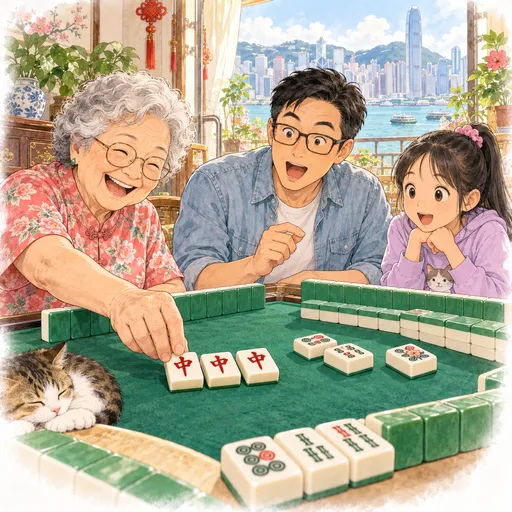
If several players want the same discard, priority is:
| Order | Claim | Notes |
|---|---|---|
| 1 | Win | Always first; if two players can win, this site by default gives it to the player next in turn after the discarder |
| 2 | Pung, kong | Anyone may claim |
| 3 | Chow | Only the next player, and only if nobody wins, pungs or kongs |
Once you chow or pung, your hand is no longer concealed (1 fan), so don't claim everything you can.
Winning: four sets and a pair
A winning hand is 14 tiles made of four sets plus a pair. A set is a run (), three of a kind () or a kong.
One tile away from winning is called being ready. Then:
- Win on a discard: someone discards your tile and you call it.
- Self-draw: you draw it yourself, which adds 1 fan.
The only win that is not four sets and a pair is Thirteen Orphans: one each of the 1s and 9s of every suit and all seven honours, plus a pair of any of them — an instant limit hand.

More waits and winning shapes are in Winning hands.
The 3-fan minimum: counting fan
The single most important Hong Kong rule: a complete hand also needs 3 fan to win. A hand short of fan is a "chicken hand", and here — as at most Hong Kong tables — you may not win with it. Your fan is the total of every scoring element in the hand, counted up to a limit of 10 fan.
The hand below is scored live by this site's scoring engine, exactly as in the game:
Won on a discard
| Concealed hand (門前清) | 1 |
| Dragon pung (三元牌) | 1 |
| Own flower (正花) | 1 |
| Total | 3 fan |
|---|
Anything over 10 fan scores 10 (the limit).
The same kind of complete hand falls short if you have claimed tiles and hold no scoring sets:
Won on a discard
| All chows (平糊) | 1 |
| No flowers (無花) | 1 |
| Total | 2 fan |
|---|
Anything over 10 fan scores 10 (the limit).
The fan beginners use most to reach three:
| Element | Fan | How |
|---|---|---|
| Concealed hand | 1 fan | No chow, pung or exposed kong |
| No flowers | 1 fan | Not a single flower |
| Self-drawn | 1 fan | Draw the winning tile yourself |
| All chows | 1 fan | All four sets are runs |
| Dragon pung | 1 fan | Each set of Red, Green or White |
| All pungs | 3 fan | All four sets are three of a kind |
| Mixed one suit | 3 fan | One suit plus honours |
| Pure one suit | 7 fan | Everything in one suit |
Every element and its fan is in the fan table, each with its own page; the guide's Fan table chapter covers the basics.
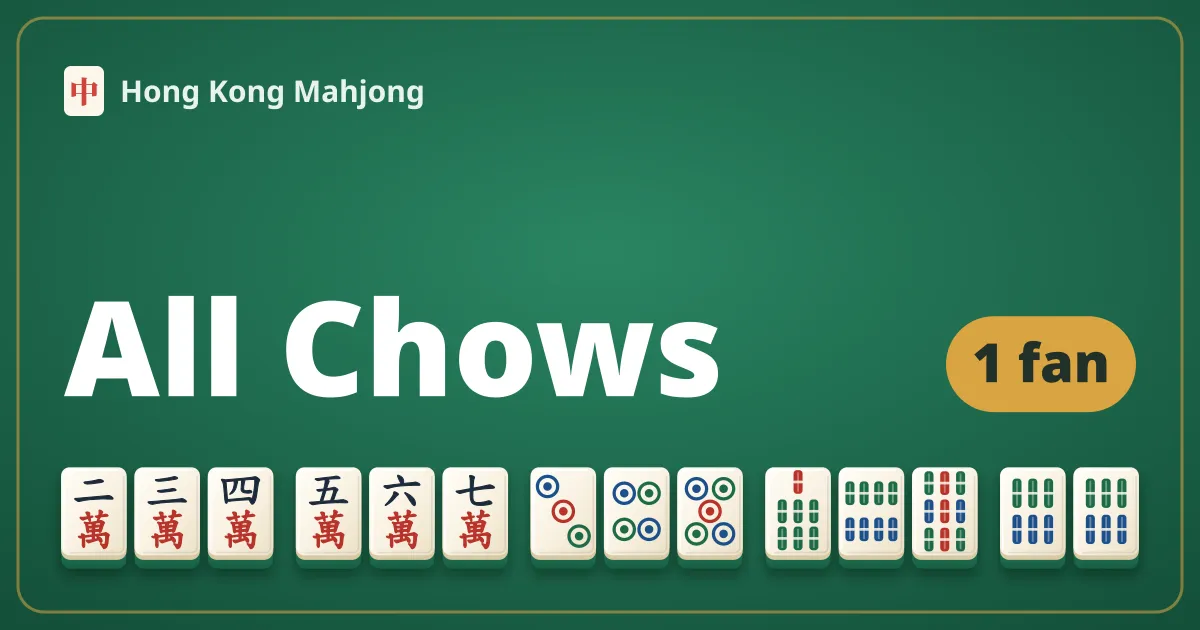 All Chows 1 fan
Four chows and a pair is 1 fan: how it differs from a chicken hand, open hands, building 3 fan, and how common it is.
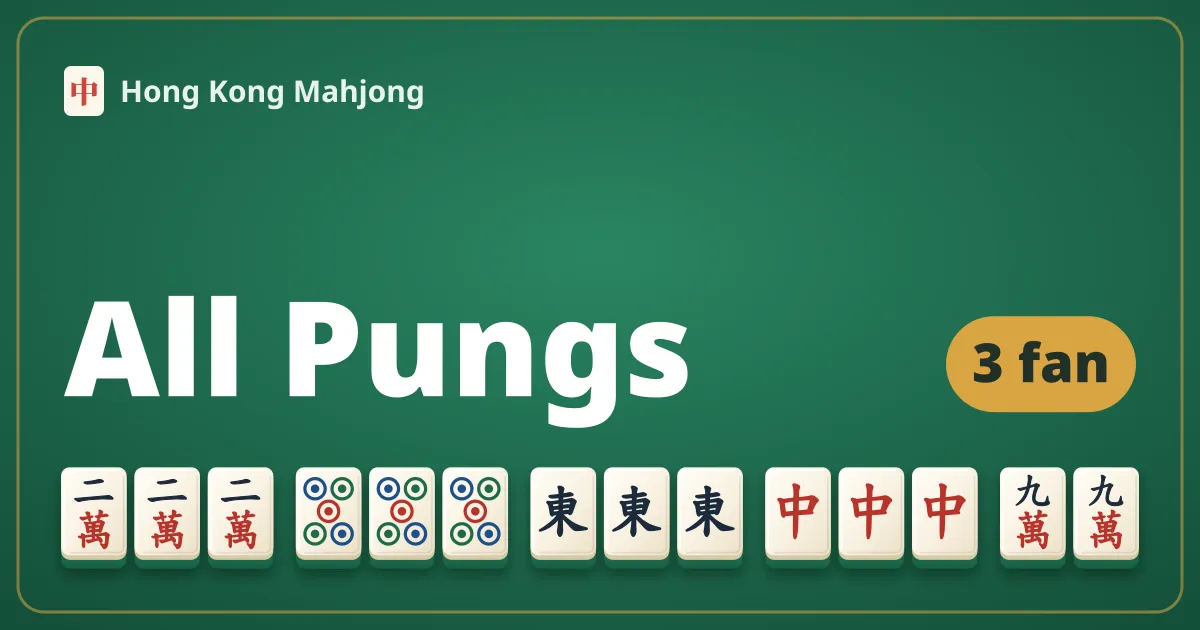 All Pungs 3 fan
Four pungs and a pair, no chows — 3 fan, exactly enough to win. Examples, scoring combos and how many pairs you need to go for it.
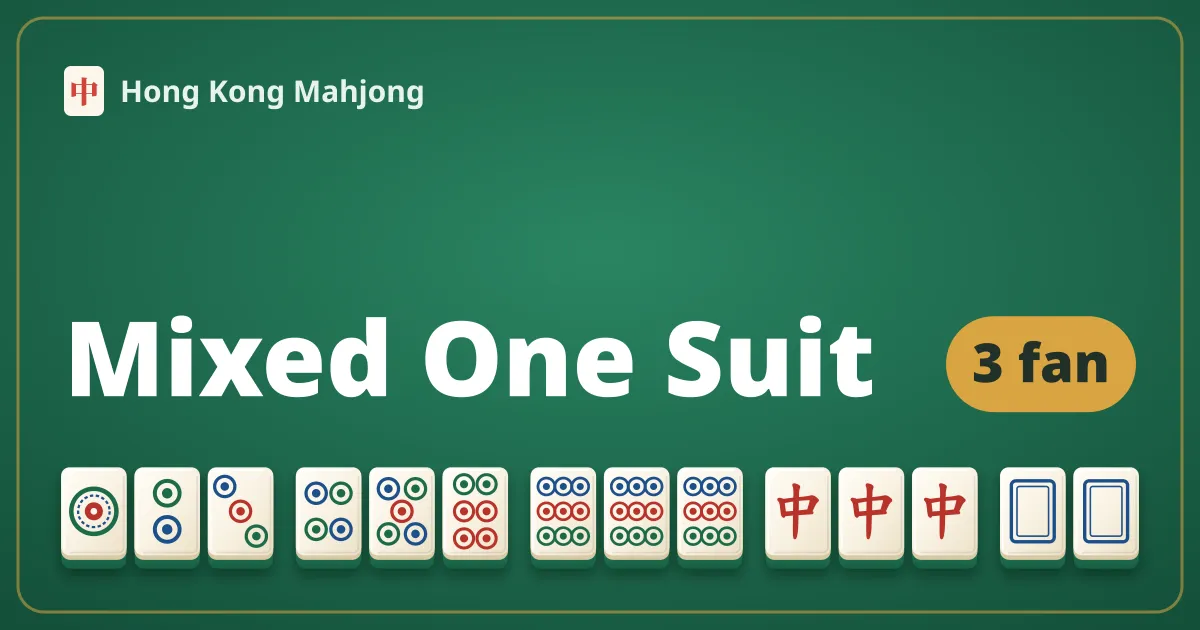 Mixed One Suit 3 fan
One suit plus honours — 3 fan, enough to win by itself. Examples, the difference from Pure One Suit, combos and how many tiles you need to go for it.
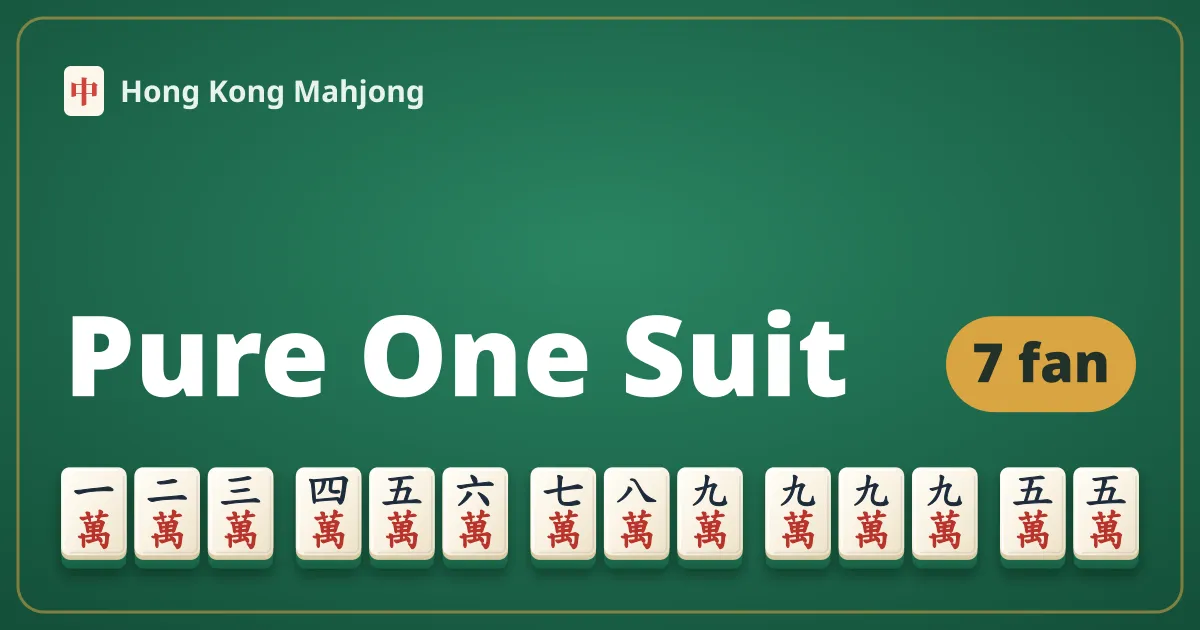 Pure One Suit 7 fan
Every tile from a single suit — 7 fan, one step from the limit. Examples, Mixed vs Pure One Suit, and how many suited tiles you need to go for it.
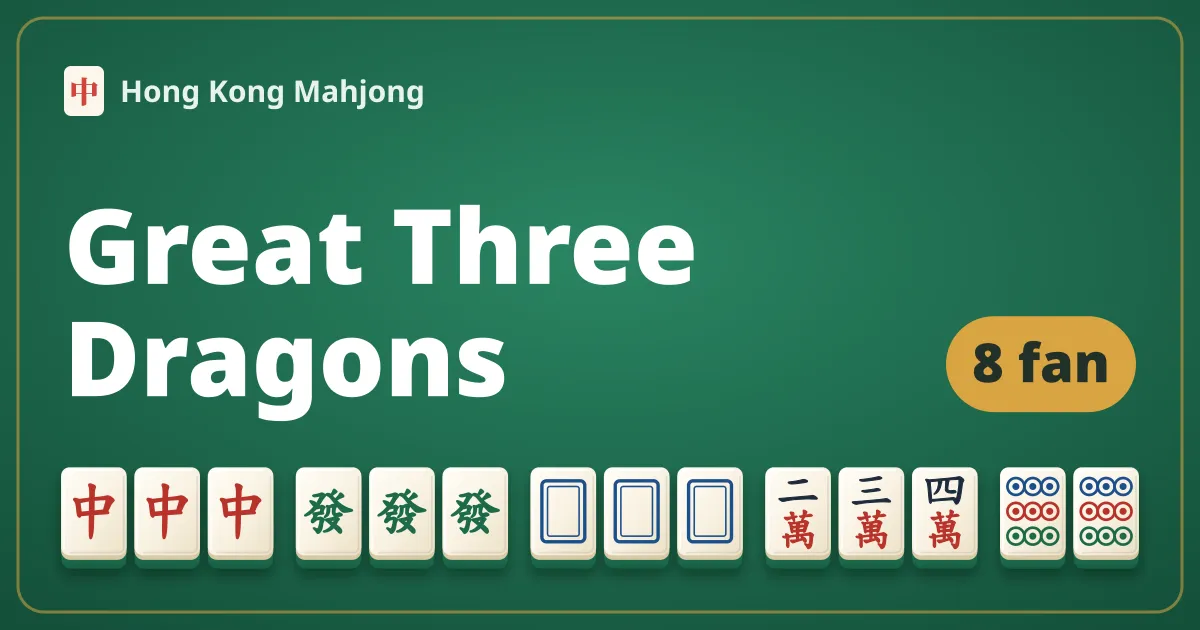 Great Three Dragons 8 fan
Pungs of Red, Green and White — an 8-fan big hand: examples, the difference from Small Three Dragons, when it hits the limit and how many dragons you need.
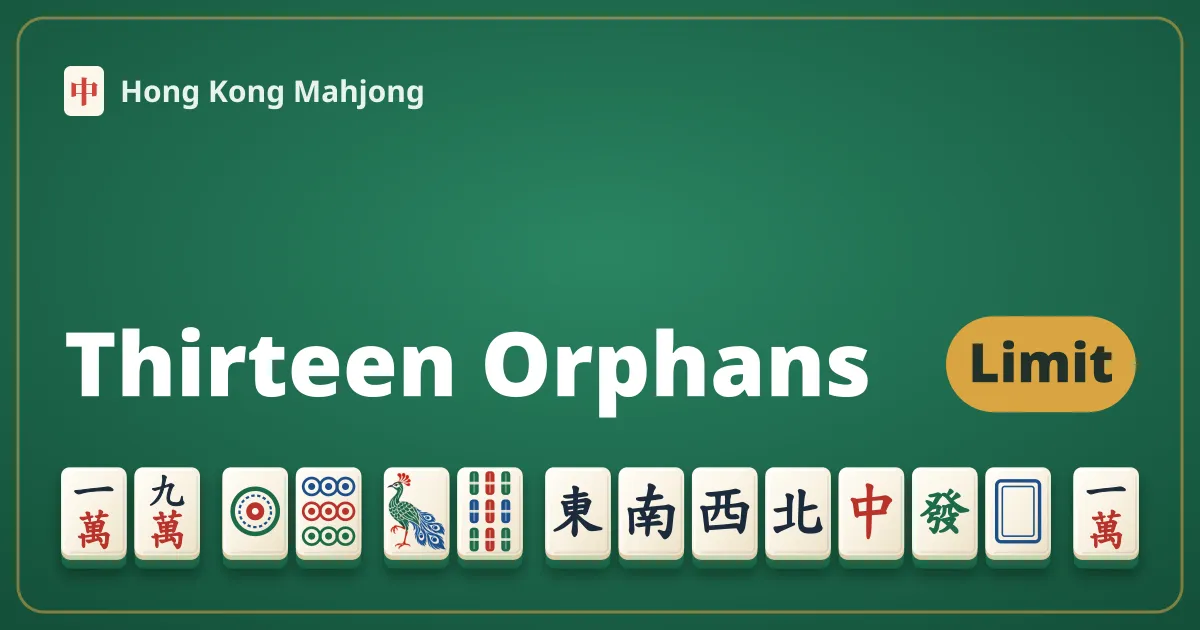 Thirteen Orphans Limit
One of each of the thirteen terminals and honours plus a pair: a limit hand, no claims allowed, with up to a 13-sided wait.
Who pays: discard vs self-draw
Fan are first converted to "base points" on the half-spicy scale: doubling for each fan up to four, then alternately ×1.5 and about ×1.33.
- Win on a discard: by default the discarder pays alone — two shares — and the other two pay nothing.
- Self-draw: each of the three others pays one share.
For example, a three-fan win at 1 point per base: three fan is 8 base. On a discard the discarder pays 16; on a self-draw each player pays 8, so you collect 24.
| Fan | Units (half-spicy) | Discarder pays | Self-draw, each pays | Units (full-spicy) |
|---|---|---|---|---|
| 3 fan | 8 | 16 | 8 × 3 | 8 |
| 4 fan | 16 | 32 | 16 × 3 | 16 |
| 5 fan | 24 | 48 | 24 × 3 | 32 |
| 6 fan | 32 | 64 | 32 × 3 | 64 |
| 7 fan | 48 | 96 | 48 × 3 | 128 |
| 8 fan | 64 | 128 | 64 × 3 | 256 |
| 9 fan | 96 | 192 | 96 × 3 | 512 |
| 10 fan · Limit | 128 | 256 | 128 × 3 | 1,024 |
Some tables play "discarder covers the self-draw": the discarder pays all three shares. You can choose it in the lobby's table rules. Full details are in Scoring and payouts.
Special Hong Kong rules
- Limit: fan count up to 10 at most; anything above still pays 10. Limit hands such as Thirteen Orphans, Four Concealed Pungs, Big Four Winds, All Honours and Heavenly Hand go straight to the limit.
- No dealer bonus: the dealer wins and loses the same as anyone else, and repeat deals add nothing.
- Repeat deal and dealer rotation: if the dealer wins or the hand is drawn, the dealer deals again; if anyone else wins, the deal passes to the dealer's right. When everyone has dealt, the prevailing wind moves on.
- Draws: Hong Kong rules keep no dead wall — a hand is only drawn after the last tile is taken, and nobody pays.
- Win on a kong replacement, last tile, robbing a kong: self-drawing a kong replacement (1 fan), self-drawing the very last tile (1 fan), or winning on the tile someone adds to their pung (1 fan). A flower replacement does not count as a kong replacement, and a concealed kong cannot be robbed.
- Eight flowers, seven robs one: collecting all eight flowers wins at the limit; if you hold seven and another player draws the eighth, you win at once and the player who drew it pays.
- False win: at a real table, calling a win with a wrong or short hand is a false win and usually costs a penalty (it varies; a common one is paying all three players as if they won at the limit). The game here cannot produce a false win: if the hand is wrong or short of fan, the win button simply doesn't appear.
Beginner tips

- Count fan from the start: look for dragon or wind pairs, your own flowers and tiles that lean towards one suit, then pick a target.
- Don't chow lightly: claiming loses the concealed fan, and that is why so many all-chow hands end up short of three. Pung dragon pairs freely, though.
- Discard lone honours first: a single wind or dragon with no pair rarely helps and is easy for others to pung, so let it go early.
- Keep two-sided runs: waits on and , twice as good as waiting only on .
- One suit gets you there: one suit plus honours is mixed one suit for 3 fan — enough on its own.
- Read the discards: a player showing several sets in one suit is probably going for a flush, so be careful with that suit and honours; a tile someone just discarded that nobody claimed is usually safer to follow.
- Learn from the ready hints: the game shows which tiles you are waiting on and how many fan each is worth — the fastest way to learn.
Play now
You don't need to remember every rule — a few hands and it clicks. Hong Kong mahjong online is free, needs no download or sign-up, and pits you against three computer players at beginner, normal or expert level, with fan counted for you and a warning when you're short.
To go deeper, start with Play your first game in the beginner's guide, or just start a game.
FAQ
How do you play Hong Kong mahjong?
Four players hold 13 tiles each and take turns to draw and discard, claiming others' discards for chows, pungs and kongs. The first to complete four sets and a pair with at least 3 fan wins, and the losers pay according to the fan.
How many fan do you need to win in Hong Kong mahjong?
This site uses a 3-fan minimum by default: a hand with fewer than 3 fan cannot win, not even by self-draw. You can lower it to zero or one fan in the lobby's table rules.
How many tiles are in a Hong Kong mahjong set?
144: 36 each of Characters, Dots and Bamboo, 28 honours and 8 flowers. Each player holds 13; the dealer starts with 14.
Who pays on a discard and on a self-draw?
On a discard, the discarder alone pays two shares; on a self-draw, each of the three others pays one share. Some tables make the discarder pay all three shares instead.
How is Hong Kong mahjong different from Taiwanese mahjong?
Hong Kong mahjong uses 13-tile hands, a 3-fan minimum, fan-based payouts and a limit; Taiwanese mahjong uses 16-tile hands, has no minimum, pays by tai, and adds dealer and repeat-deal tai.
What does "limit" mean?
Fan above the cap (by default 10) still pay only the cap — the limit. Limit hands such as Thirteen Orphans, Four Concealed Pungs and Big Four Winds score the limit directly.
What is a false win?
Calling a win with a hand that is wrong or short of fan is a false win, which usually costs a penalty at a real table. The game here only shows the win button when the hand is genuinely complete and has enough fan, so a false win can't happen.
Try it at the table
Hong Kong Mahjong — Play classic Hong Kong (Cantonese) mahjong free in your browser against three computer opponents. 13-tile hands, flowers, 3-fan minimum, 10-fan limit and automatic fan scoring. No sign-up, works on phone and desktop.